Friday, March 14, 2014

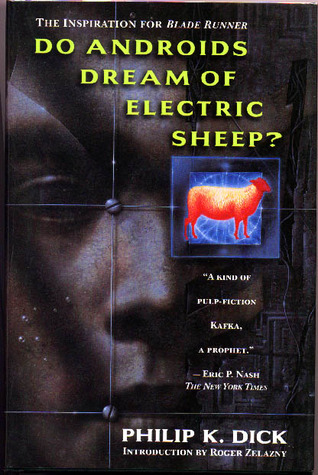
Hall: Androids Dreaming

"Irans attention is never properly directed towards Rick, as one might believe with them being married and all. Rather she exists in her own little world, a world consisting of her compassion for Wilbur Mercer, the Penfield organ and first the sheep, then the goat and lastly the toad. Her compassion, representative for the rest of humanity, towards the animals seems to be rather fleeting. Although she seems at first crushed over the loss of the goat, her attention immediately moves onto the toad as soon as Rick walks in the door with it. And here it’s worth noting that the toad is synthetic, contrary to the real goat” Heilemann 6). 

To some degree, I agree with Michael's assessment of Iran's behavior, but I find his overall interpretation to be rather limited. While Iran definitely exists within a rather alienated world, I think she, like Rick Deckard, is trying to escape this world of simulation in the pursuit of reality. That is, a more tangible, hopefully comprehensive reality. The reality of World War Terminus is a confusing mixture of synthetic, organic, and mechanic. 
Iran’s unhappiness with her “own little world” can be seen in the first chapter and first scene of Do Androids Dream of Electric Sheep (Heilemann 6). The scene begins with a discussion between her and Rick, and their usage of the Penfield mood organ. While Rick seems extremely comfortable with letting the mood organ dictate his emotions and keep him in a more serene place of self-fulfillment, Iran seems to fight against the mood organ as a method of happiness or good will. She outlines her unhappiness with the organ and her (almost rebellious) decision to program a twice-monthly mood of despair and depression.
"I don't feel like dialing anything at all now," Iran said.
 "Then dial 3," he said.
"I can't dial a setting that stimulates my cerebral cortex into wanting to dial! If I don't want to dial, I don't want to dial that most of all, because then I will want to dial, and wanting to dial is right now the most alien drive I can imagine; I just want to sit here on the bed and stare at the floor" (Dick 3).
It is only after Rick’s incessant pestering that she invoke the powers of the mood organ, that she finally gives in and allows him to administer dial 594 “pleased acknowledgment of husband's superior wisdom in all matters” (Dick 3).
By the way, it is incredibly creepy to me that 594 is a dial on the mood organ, dial 888 is also a bit disconcerting (“the desire to watch TV, no matter what’s on it”), but I find that a bit more funny than unsettling.
This first scene also refutes Heilemann’s claim of Iran’s diminutive empathy with her resentment towards Rick and his profession. Although it can be argued that she is simply badgering and goading him to start a fight, she seems to at least have some empathy towards the androids her husband professionally retires.
"You're worse," his wife said, her eyes still shut. "You're a murderer hired by the cops.  "I've never killed a human being in my life." His irritability had risen, now; had become outright hostility.  Iran said, "Just those poor andys."
I also don’t agree with Heilemann’s evaluation of Iran’s compassion as “fleeting” (6). This may be the case, but I do not think he reinforced this idea with adequate proof or argument. While he notes that the toad is synthetic, contrary to the real goat,” he forgets to mention that the sheep was also synthetic. It is unknown whether she really did mourn the sheep when it first died, or what connection she really had to it, since it is implied that Rick was the primary caretaker. Perhaps she did not have a strong connection to the sheep because of this. Also since they have had the electric sheep for about a year, perhaps she did grieve for sometime after the sheep died. They only possessed the goat for a couple of hours before Rachel dispatched it to the great Mercer in the sky, so it would have been hard for her to actually establish a lasting emotional connection towards the animal. So his statement regarding her “fleeting” empathy towards the animals, as a “lack of emotion” is erroneous without proper evidence that this is an inability that connotes cold behavior (Heilemann 6).

Works Cited 

Dick, Phillip K. Do Androids Dream of Electric Sheep? New York: Ballantine, 1996. Print. 

Heilemann, Michael. "Do Androids Dream of Electric Sheep and Blade Runner" Print.

Gaspari: Androids

In Michael Heileman's essay analyzing "Do Androids Dream of Electric Sheep" there is a focus on dehumanization and the focus on what human-ness is. Heileman focusses on the idea the ideas of mercerism, "Mercer is also for mankind a way to separate themselves from the androids, seeing as their lack of empathy makes them unable to use the empathy box" (Heileman, 8). I think that there is clear evidence in the novel that shows that the empathy box and the Voight test actually blur the lines between android and human and can cause the perception of what human is to be almost imperceptible. The issue that comes with this goes along with how Roy Baty uses drugs to try and induce an empathy response through the effects of an altered state, and also there is the problematic issue of the Voight test not actually being completely effective as we see when it fails on Rachel Rozen.

Mercerism is as a whole uneffective and does not accomplish what it is set out to do. If the goal is to define a human identity that is separate from the machines, there is an inherent flaw. This flaw comes from the empathy box, a machine, playing a major role in Mercerism. The problem of the empathy box is clear as it does not provide identity it only provides a communality. Deckard shows how manipulative the machine is and how much they depend on the empathy box when he is arguing with his wife early on in the book. The identity that the empathy box pushes on individuals strips away their personality and is actually a clear fake. In the end we see this as Mercer is outed as a con and he admits, "I am a fraud" (214, Dick). This bit of information is very vital, because it further complicates the roles that are played in the novel, but I think the one thing that it does confirm is that religion in this book does not effect humans in a positive manner. 


    Works Cited

Dick, Phillip K. Do Androids Dream of Electric Sheep? New York: Ballantine,

          1996. Print.

Heilemann, Michael. "Do Androids Dream of Electric Sheep and Blade Runner". 2001. Blackboard. Web 13 Mar 2014

Mather - Androids Blog

In the essay by Michael Heilemann concerning the book Do Androids Dream of Electric Sheep and Blade Runner, he claims that the Penfield mood organ is a device that brings humans down to the level of androids, that it is the primary source of human emotion in the book, that "emotions are reduced to numbers" (Heilemann 5). I disagree with this claim, while the mood organ does artificially alter the mood of the characters in the book, it does not bring humans to the same level as the androids. The characters in the book actually refuse "dialing" in multiple times, because they want to keep feeling what they're currently feeling. This shows that they still have control over their normal, human emotions, and are not programmed like the androids are.


In the beginning, Iran refuses to dial in, citing that "wanting to dial is right now the most alien drive I can imagine." (Dick 3) By refusing this, she is accepting her human emotion to feel apathetic, which is something the androids don't feel. Her use of the word alien is an important one, because at this point that is what the androids should, and are considered to be, alien. They are not human in the sense that they feel the same emotions, and are regulated by the same neural pathways, but they are human in the sense that they have a consciousness in which they can resemble humans, but they will never BE human.
Interestingly enough, Rick Deckard is another character that doesn't need to dial in. This occurs at the end of the book, when he is finished with his assignment, and has returned home. "And then, by degrees, he progressed along the route to the bedroom. 'Okay,' he said. 'Long deserved peace.' he stretched out on the bed, dust sifting from his clothes and hair onto the white sheets. No need to turn on the mood organ, Iran realized". (Dick 96) After his ordeal, he recognizes that he deserves some peace and quiet, and gives in to being dialed, but his wife realizes that he doesn't need to, his current emotions are sufficient enough to bring about the desired effect. This proves that humanity is not lost, and that not everyone is giving into the "alien" desires to alter their mood. Yet altering mood is not a foreign concept to humans, we have been doing it since the dawn of time, with various substances. In a way, the mood organ is simply another substance that alters moods. So I would argue that the mood organ is simply another substance humans use to alter their mood because their current reality is not something they want to deal with sober.


Works Cited

Dick, Phillip K.
Do Androids Dream of Electric Sheep. New York City: Doubleday, 1968. Review of     Resources. Web. 14 Mar. 2014.

Heilemann, Michael. "Do Androids Dream of Electric Sheep and Blade Runner." Web. 14 Mar. 2014.

Tom Mather

O'Connell: Androids Blog

Michael Heilemann’s essay promotes many interpretations of Do Androids Dream of Electric Sheep that are relatively obvious and acceptable, however in his conclusion, he postulates that in relation to the androids, the novel’s “real” humans are:
Stupidified by 23 hours of moron-TV every day, unable to provoke emotions except through a mechanical device and blinded by their devotion to their new religion. A religion which no one really understands or even makes an effort to understand, it’s merely accepted as yet another possibility of total escapism. (Heilemann 12)
This is an opinion that I feel conflicts with many of the novel’s statements about humanity, and the nature of Mercerism.

Though Mercerism is presented as a religion, I believe its role for mankind is not to inspire blind devotion or similar escapism to Buster Friendly’s 23 hour broadcast, but to remind the followers of their humanity. Empathy is the measurement by which the androids are considered insufficient to be human, therefore the greater one’s empathy, the greater their humanity. Through reassurance and communal compassion, the Mercerists are kept in touch with their truly human natures. Not necessarily by literal definition, as a man like Phil Resch, though human, is a killer, lacking in the (figuratively) humanizing empathy. New, updated versions of androids are constantly being released, getting closer and closer to this ideal of human that many humans are unable to reach. Luba Luft criticises Resch openly for his android-like lack of empathy, to the point that she is convinced he is one. After being given the book of Edvard Munch prints by Deckard, Luft says of Resch “It wouldn’t have occurred to him; as he said, never in a million years.” (Dick 133) As the line between organic and electric is already blurred to this point, the androids are obviously on a track towards indistinguishability from humans as they improve and get closer to empathic response.

It is not simply the humans’ attempting to foster artificial exclusivity by stating the unachievable by the androids. Consider Isidore’s distraught conversation with the Mercer via the empathy box, immediately after his exposure as a fraud.  
“I am a fraud,” Mercer said. “They’re sincere; their research is genuine. From their standpoint, I am a retired bit player named Al Jarry. All of it, their disclosure, is true.” [...] “They will have trouble understanding why nothing has changed. Because you’re still here, and I’m still here. (Dick 214)
The point of Mercerism is not the divinity of the figure, Mercer, but the empathy itself through the vehicle of Mercer’s ceaseless pilgrimage and hardship. It is only the lack of compassion that keeps androids from achieving humanity. Theoretically, if the androids were to reach such a tier of empathy, they would finally be truly equal to humans.


Works Cited


Dick, Philip K. Do Androids Dream of Electric Sheep? New York: Ballantine, 
1996. Print.


Heilemann, Michael. “Do Androids Dream of Electric Sheep and Blade Runner”. 2001. Blackboard. Web. 13 Mar 2014.

Wlos: Android Book


          Do Androids Dream of Electric Sheep and Blade Runner is an essay written by Michael Heilemann that offers words of analysis on Do Androids Dream of Electric Sheep, a 1968 novel scripted by Philip K. Dick.  While reading this essay, it can be noted that Heilemann has dissected Do Androids Dream of Electric Sheep with a distorted viewpoint.  This can be observed on page seven of his paper, when he states “. . .reality is that androids are the enemy of society and the feelings are something you get through Mercer and the organ, not something that spontaneously arise, and especially not toward androids (Heilemann 7).”  Specific examples from Dick’s text clearly display that the author of the book did not construct a world in which feelings come from an object that is independent of humans (i.e. Mercer or the organ), such devices merely manipulate human feelings.  Human feelings remain a unique output of humans.  This is most evident by the fact that androids cannot be given feelings.  If someone can create a mood organ that creates feelings, why can they not create an android that creates feelings?
            To comprehend the phenomenon of empathy and how it is designed to exist within the world of the book, Dick provides us with a specific understanding on page 30 of the novel, “An android, no matter how gifted as to pure intellectual capacity, could make no sense out of the fusion which took place routinely among the followers of Mercerism—an experience which he, and virtually everyone else, including subnormal chickenheads, managed with no difficulty (Dick 30).”  This statement provides evidence that Dick scripted the novel with the intention to create a reality in which the occurrence of empathy could not be explained by the tactics of intellectual capacity, but is instead, a phenomenon that occurs within humans.  This statement therefore disproves Michael Heilemann’s claim that . . .”feelings are something you get through Mercer and the organ, not something that spontaneously arise. . . (Heilemann 7).”  How could someone create a mood organ if the fusion of feelings is something that cannot be made sense of with intellectual capacity?  Clearly the mood organ affects and manipulates human feelings, but it does not create them.
            On page 142 of Do Androids Dream of Electric Sheep, Rick Deckard states, while conversing with Phil Resch, “I’m capable of feeling empathy for at least specific, certain androids (Dick 142).”  This claim by Deckard illustrates a logistical flaw in Michael Heilemann’s belief that “. . .feelings are something you get through Mercer. . . (Heilemann 7).”  The empathy that is spread through Mercerism cannot be experienced by Androids, as we learned by observing the page 30 quote, “An android, no matter how gifted as to pure intellectual capacity, could make no sense out of the fusion which took place routinely among the followers of Mercerism. . . (Dick 30).”  It is known that the followers of Mercerism feel empathy towards each other, but does empathy come purely through Mercerism, as Heilemann argues?  No, it does not, otherwise Rick would not be able to feel it for an android, which is inherently not a part of Mercerism.
            I think that Heilemann was thinking when he wrote his piece, but he was not thinking the right things. 


Andrew Wlos

Works Cited

Dick, Philp C.  Do Androids Dream of Electric Sheep.  New York:  Del Ray, 1968. 

Print.

Heilemann, Michael.  Do Androids Dream of Electric Sheep and Blade Runner.  Print.

Fisher: Androids


                I chose to dispute the author’s opinion of Iran’s empathic feelings in Do Androids Dream of Electric Sheep. The author claims that Iran “exists in her own little world, a world consisting of her compassion for Wilbur Mercer, the Penfield organ, and first the sheep, the goat, then lastly the toad” (Heilemann 6). Although Iran does keep herself preoccupied with these material things, she displays a wider acknowledgement for the world around her. When Iran explains her mood schedule to Rick, telling him, “’My first reaction consisted of being grateful that we could afford a Penfield mood organ. But then I read how unhealthy it was, sensing the absence of life, not just in this building but everywhere, and not reacting - do you see?’” (Dick ch. 1). She first expresses her distaste for owning a mood organ, showing her lack of concern for her and Rick’s possessions, a sentiment echoed by her earlier dismissal of Rick’s complaint of not owning a real sheep. In this statement, she also shows her concern with her inability to feel shows her desire to be part of the outside world again. However, she understands that this world has essentially died off, which perhaps explains her devotion to Mercerism as it is the only way to properly contact other human beings. Since she displays such an acute awareness of her situation in life and the state of the environment she lives in, I would hardly say that she is incapable of true empathy.

                The author goes on to point out her disinterest in Rick as a person, stating “Iran’s attention is never properly directed towards Rick, as one might believe with them being married and all” (Heilemann 6). When Rick returns from his trip to the desert, Iran expresses concern for his well-being twice. First, when she discovers that the toad is electric and sees the disappointment that consumes Rick, she says, “’Maybe I shouldn't have told you - about it being electrical.’ She put her hand out, touched his arm; she felt guilty, seeing the effect it had on him, the change” (Dick ch. 21). Her main priority is not ownership of the toad or righteousness over proving her husband wrong, or even disappointment over the discovery that the toad is fake. Rather, her first inclination is to check on her husband’s emotional state. Next, after he laments his day’s activities to her, she comforts him by saying, “’I'm just damn glad to have you come back home where you ought to be.’ She kissed him and that seemed to please him; his face lit up, almost as much as before - before she had shown him that the toad was electric” (Dick ch. 21). Although she could have easily blamed Rick for the incident with the goat or ridiculed him for believing the toad was real, she disregards both animals and is only interested in having her husband there. Thus, we can see that perhaps they both act like a married couple after all.

The author also says that “Her compassion, representative for the rest of humanity, towards the animals seems to be rather fleeting. Although she seems at first crushed over the loss of the goat, her attention immediately moves onto the toad as soon as Rick walks in the door with it” (Heilemann 6). I think in this case it is important to point out that Iran was the one who realized that the toad Rick finds was electric. She does not place it on a pedestal as Rick does and sees past the façade that hope can sometimes bring. Therefore, I would not say that her compassion is fleeting, since she was obviously not so enraptured by the possibility of finding a live toad that she was willing delude herself into believing it was real.

Sunday, March 2, 2014

Szklarski: Crystal Skull

Even though this film comes into the series nineteen years after the premiere of Indiana Jones and the Last Crusade, fans of the man with the most recognizable hat in the world were fine with the wait. Sales and popularity of the earlier films soared in the anticipation of the next chapter in the Indiana Jones saga. Knowing full well that there was a lot to live up to, the cast and crew worked hard to make this installment a sensation. Marketing for this film relied heavily on nostalgia of the public viewing audience. Products took inspiration from all of the films. Using this pent-up demand for new Indy after nineteen years of absence, the film needed to have enough homage to the earlier films to satisfy the nostalgia. This film needed references from and similarities to the earlier films. Many elements of this 2008 film were kept consistent with the original trilogy out of respect. Stunt doubles were used, rather than computer generated images, and timed explosives were used again. 

The film, as it is not as much of an homage as it is a parody, makes fun of certain aspects of the character and situations he somehow manages to escape from. The one that I consider to be most comical, or worth of being a parody, involves quicksand.


This scene is a parody from the times that Indiana Jones has flipped out because of snakes in mainly Raiders of the Lost Ark but also The Last Crusade. To myself and American culture, fear of snakes has always been synonymous with Indiana Jones. When I was little, I refused to go to the reptile exhibit. I loved adventure, thrill rides, and looking at lions. Although when it came to snakes, my dad called my Indiana Jones because I could handle literally everything besides snakes. In this scene, Indiana is stuck in the worst kind of trap. Any wrong move and he could be lost forever. His only lifeline is also his worst fear.Indiana can't fathom touching this snake even though it would save his life. Marion and mutt have to call it a rope before he can touch it. It's almost the epitome of everything going wrong at once. This concept is not new to Indiana Jone's character. Why'd it have to be snakes? Well, it is because Indiana Jones has faults. He is not invincible. His past always catches up with him. In this film, it is not only in the fact that this manly, adventurous hero can't even look at snakes without getting the willies, intended.  It is also that his relations and foibles with Marion have resulted in him having no knowledge of the son he fathered.