Showing posts with label Emily Szklarski. Show all posts

Wednesday, May 7, 2014

Szklarski: Irish Films

Both Patriot Games and The Devil's Own portray the 'same' group of people in strikingly different ways. The I.R.A does not change however, the audience's alliances are shifted. The way that each antagonist is shown in terms of their caring nature or humanity is very different between films. I had difficulty finding a picture of a scene to use for analyzing Sean Bean's character in Patriot Games. Sean Miller is presented as a blood-hungry terrorist blaming his way through Ulster, London, America, and Libya, coming out of the water, airborne, in your attic, nursing a monumental grudge, and just utterly scary. In this frame, Miller is certainly the dominant. All are dressed in black, making the bulk of the image rather dark. No matter what side of the situation people lie, there is potential for corruption. The social camera proxemics allow for us to see more than just Miller in this frame. This allows us to compare him to the people around him. Miller is the only character not wearing a hat. The hats on the law enforcement men around him show their lawful alignment. Miller is lawless and does not follow the rules or social order set by governments or humanity. Miller's rogue and grudgey nature is captured in his hat-lessness. Jack Ryan interferes with the assassination and therefore becomes more of an enemy than Miller's previous opposition.


Frankie's situation is premised with the opening scenes of The Devil's Own. Brad Pitt's character is presented as more of a struggling person than a madman. The empathy we show toward him starts with seeing the scene is grown out of seeing a young boy's father get shot at their dinner table.


In this scene, the gunman that breaks in is viewed from how young Frankie would see him. The low angle of looking up at the gunman puts us in a seat right next to Frankie at the table and the empathy begins. The low key lighting here creates strong contrasts between the mask and the gun versus everything else. The dominant in this scene is eyes. My eyes were first drawn to the face of the gunman because I wanted to see who it was that just barged in. His entrance was such an interruption to the happy, peaceful family dinner. His eyes emerge out of the darkness of the mask. The black anonymity of the mask shows the faceless violence. There is no face to the violence until one side decides that certain men are the cause of it, when in reality, it is the   It is a direct descent into the darkness that envelops the rest of the movie, at least in comparison to the happy Irish music. There are many instances in which we see Frankie is not a heartless wench. We feel his feelings when his friend is shot and must be left behind during the battle in the apartments. He plays football with the can in the streets as he jokes around with his friend he was just reunited with towards the end of Act 2. Overall, Frankie's cause is portrayed as being targeted by the enemy, whereas Sean Miller is the enemy.

Emily Szklarski

Friday, April 4, 2014

Szklarski- The Witness

The title clearly refers to little Samuel Lapp. However, in a sense, John Book is a witness as well. He bears witness to the deep community bond and lifestyle of the Amish. John Book is witness to what violence dos to the soul. He gains a greater understanding of what it means to lose the meaning. He also becomes more understanding of the Amish community selflessness. Being a witness refers to an outsider who has a visual of some event. In the court room, the witness’ testimony is crucial in the decision making process of the jury. The witness is supposed to be on the outside looking in. John Book is a hero because of his actions and because of his personal growth. "The most rewarding aspect of the film is not the crime story---which is a rather predictable affair populated by standard cop-movie characters (i.e., the corrupt superior officer, the partner who turns out to be the film's sacrificial lamb, the black gangster who is mistakenly rousted by cops in their obsessive search for the murderers). Rather, what makes Witness unique is its painstaking and loving depiction of life among the Amish"(Pfeiffer, 151). John Book’s change in his understanding of the Amish is the poster for this appreciation that the audience gains by the end of the film.

John Book has a propensity for violence. He is a cop in a city with crime and police corruption. His world is full of people looking out for themselves and climbing to the top by any means necessary. It is ingrained in his ways just as much as the peaceful life in ingrained in the Amish. The tendency for violence does not make John Bok any less venerable of a character. No matter what he does, he has not lost ‘the meaning’ as Schaefer has in the timeline of the movie.

There is a huge difference between understanding and actually changing. John Book does not belong in the community. Rather, he understands the value of every part of it. It does not mean that it is better than his life in Philadelphia. It simply means that John Book as a person has grown and that too much of a change would just result in a different person. There’s a reason that most of the population of the world does not totally drop everything and enter a new way of life. People are shaped by their world around them. Our experiences do not make up every single possible part of who we are. There’s obviously more to a person than the things he or she does every day. But it can’t be ignored that experiences and decisions are a large part of who a person is. As John Book experiences the world of the Amish, he deepens his scope of what justice is. The rural lifestyles are actually more ‘sophisticated’ than the supposed civilization of the city. The value of life is held to a much greater height in Lancaster than it is in Philadelphia. John Book also does not force anything between him and Rachel. He respects her ways and her world. John Book becomes a more caring person. John Book used to respect authority, however he changes to now respect people and the law above authority.

John Book retains his pride; an aspect looked down upon in a society based on simple living. John is proud of being a carpenter signified in his restoration of the birdhouse. John Book does not change in this way, a further point that he does not belong in such a community. The unwelcoming nature of pride can also be seen in the way that Samuel Lapp responds to his toy gift.


Emily Szklarski

Friday, March 28, 2014

Szklarski- Director's Cut


The Directors Cut shapes the story line into a more apt reflection of the book's lingering cliffhanger of the humanity of Deckard. The most salient meaning of the film is the blurring of the line between androids and humans. Unlike the first realese of the film in 1982, to the director Ridley Scott's dismay, the 1991 version leads the audience to question whether or not Deckard is a replicant. The definition of humanity is not easily stated. The culture of the future city of Los Angeles in the movie structurally defines humanity very different from than the functional definition which is measured by the Voight-Komff test. As Rachel remarks, Deckard has never taken the test himself. It is totally possible that Rachel passes this test with more flying colors than Deckard ever could, provided that Deckard really has been an android all this time. 

Ridley Scott thought it was necessary to change the film. As mentioned in class, he stated what most should consider as the most ginormous spoiler alert of all time in an interview shortly before the movie came out. Clearly his motive in investing so much, financially and temporally, into the film was to make the movie come off showing that Deckard was a replicant, or android, himself all along. Deckard was being forced into false pretenses of his own existence to be able to kill get rid of whatever replicant the humans decided was not longer allowed to exist. If this is the case, then the forced retirement/murder of his own kind appears to be absolutely heinous. Evoking that emotion from the audience leads to the questioning of the self as to if the skewed notion that killing someone/something of a different kind is any more 'ok.' Rachel even asks at one point whether or not Deckard has killed a human. Here, it seems like Scott is actually asking the viewers which is better; android to android death, or human android murder? Another huge hint at this alternate meaning of the film comes in the last scene of the 1991 version of Blade Runner. The unicorn dream and origami unicorn make the decision even harder for the audience. "[This] confusion was exactly what [Scott] hoped to create, and reminded the studio brass that the delicate subtleties which he labored to create would be destroyed by the narration” (Pfeiffer 124).

The essential difference for changing the perception of Deckard in this manner to me is the removal of the voice over. The presence of the voice over evokes a connection between the audience and Deckard. He becomes more human to the audience as they hear his thoughts, no matter how annoyingly and blatantly obvious the script is. Removing the voice over aids in separating the sort of human connection that it created in the original 1982 version. In my mind, the 1991 version is much more effective in eliciting the sorts of moral questions that the book raise, which is ultimately the point of science-fiction. The toying of the empathy of the viewer toward the androids is much more interesting and thought-provoking. The film is supposed to be entertaining. On top of the entertaining and 'happy-ending' rubbish provided from the 1982 version, the Director's Cut offers a version with much more substance.


Emily Szklarski

Sunday, March 2, 2014

Szklarski: Crystal Skull

Even though this film comes into the series nineteen years after the premiere of Indiana Jones and the Last Crusade, fans of the man with the most recognizable hat in the world were fine with the wait. Sales and popularity of the earlier films soared in the anticipation of the next chapter in the Indiana Jones saga. Knowing full well that there was a lot to live up to, the cast and crew worked hard to make this installment a sensation. Marketing for this film relied heavily on nostalgia of the public viewing audience. Products took inspiration from all of the films. Using this pent-up demand for new Indy after nineteen years of absence, the film needed to have enough homage to the earlier films to satisfy the nostalgia. This film needed references from and similarities to the earlier films. Many elements of this 2008 film were kept consistent with the original trilogy out of respect. Stunt doubles were used, rather than computer generated images, and timed explosives were used again. 

The film, as it is not as much of an homage as it is a parody, makes fun of certain aspects of the character and situations he somehow manages to escape from. The one that I consider to be most comical, or worth of being a parody, involves quicksand.


This scene is a parody from the times that Indiana Jones has flipped out because of snakes in mainly Raiders of the Lost Ark but also The Last Crusade. To myself and American culture, fear of snakes has always been synonymous with Indiana Jones. When I was little, I refused to go to the reptile exhibit. I loved adventure, thrill rides, and looking at lions. Although when it came to snakes, my dad called my Indiana Jones because I could handle literally everything besides snakes. In this scene, Indiana is stuck in the worst kind of trap. Any wrong move and he could be lost forever. His only lifeline is also his worst fear.Indiana can't fathom touching this snake even though it would save his life. Marion and mutt have to call it a rope before he can touch it. It's almost the epitome of everything going wrong at once. This concept is not new to Indiana Jone's character. Why'd it have to be snakes? Well, it is because Indiana Jones has faults. He is not invincible. His past always catches up with him. In this film, it is not only in the fact that this manly, adventurous hero can't even look at snakes without getting the willies, intended.  It is also that his relations and foibles with Marion have resulted in him having no knowledge of the son he fathered. 

Friday, February 14, 2014

Szklarski: 'At One Ment' does not happen all at once


     There are scenes throughout the film Indiana Jones and the Last Crusade that portray the development of Indiana's atonement with his father. At this point in the Indiana Jones Franchise history, Indiana is a well-established courageous hero who has awesome adventures with his signature hat and whip. This last installment in the trilogy brought a new element to his character.
"I insisted we complicate the character. I wanted not only the adventure, the environment, to be good, but I wanted the audience to have the opportunity to learn something more about the character. The device of introducing his father played by Sean Connery was a stroke of genius" (Pfeiffer 175). This additional element conveys the main thematic message of this film. Indiana's atonement with his father is mirrored by his achievement of a sort of spiritual achievement. Up until this movie, while he has grown in many ways, Indiana was focused on the physical world. He dealt with physical challenges. The objects he obtains are plucked from their resting places by his hands because they belong in a museum. On the other hand, his father seems to be solely in the spiritual world as far as where he spends most of his time. Henry Sr. dedicated his entire life and academic career to the Holy Grail. Essentially, the 'grail' quest is the quest for atonement. 
     We are first introduced to this dichotomy when Indiana brings the cross of Coronado back to this father to regale to him the adventure he just had. His father won't listen to him. We can see that their relationship is not a very close one. It is made clear that Indiana is not after the Grail. He is going on this quest of sorts to save his father. Indiana sees his father as more than a 'damsel in distress' as he essentially takes down a plane with the birds. It is not until Henry Sr. presumes his son to be dead, after Indiana goes off the cliff wit the tank, that he regrets the ways in which he interacted with his son. He just needed five minutes with him. Clearly, the father had not yet reached atonement with the son at that point. Another instance of atonement occurs when Henry Sr. calls him Indiana and tells him not to reach for the Grail. They value each other over the physical cup. They both contemplatively see the value of humanity over artifacts. Interestingly enough, the Holy Grail is never mentioned in the bible. The idea of the Grail never emerged until the lore of King Arthur. Arthurian Legend is the first record of mention of the Holy Grail. 

Friday, January 31, 2014

Szklarski: Skywalker as Campbell's Hero

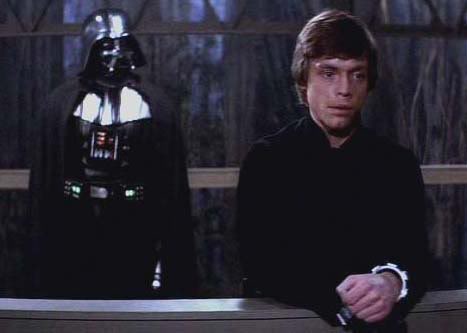
Luke Skywalker, as far as Campbell's standards go, completes the Hero's Journey in the Star Wars trilogy. Campbell's hero, with regards to steps of the journey such as Atonement with the Father, Master of Two Worlds, and the Belly of the Whale, is a better fit into the mold of a contemplative hero than a civic hero. The spiritual connection of the Force reinforces the view that the contemplative hero is like a religious hermit. Luke does not fight the physical battle on Endor. Han takes care of that side of the battle fulfilling his adherence to a civic hero role. Luke's battle takes place on the Death Star but also in his mind as the Emperor tempts him with the dark side.
I see the Emperor's throne room as an eye. The structure is similar to that of an eye; the circular form of the window and the way it has a perfect view of the battle taking place in space near the Death Star. These three characters pictured to the left all deal with what is going on behind the face, the mask. The most poignant visual representations of the Dark Side are Darth Vader's mask/cape getup and the Emperor. But the real power of the Dark Side is all in the mind, or behind the eyes. This is where the choices and decisions are made in a spiritual manner; internally.

The struggle within Luke's mind plays out visually as the scene ensues. Luke fights to what seems like the end when he calls out for his father's help. His father essentially dies saving him. Luke doesn't want to accept this as his father's fate. The point of Atonement with the Father is that each accepts the other. This is covered by Darth Vader's statement, "You already have [saved me]." He acknowledges Leia at this point as well when he tells Luke to tell his sister. 

The Belly of the Whale, a step of Luke's journey in The Empire Strikes Back, is commonly cave like. On Dagobah amidst his Jedi training with Yoda, Luke encounters himself basically. Seeing his own face behind the mask of the head of Darth Vader shows that he acknowledges that there is a piece of Darth Vader, or the Dark Side, within him. Many of the facets of his training reflect a kind of Belly in which Luke develops his contemplative side. 


Once Luke has defeated Darth Vader, which in a way brings his father back to life, he has won the internal struggle with the Dark Side. In a way, Mastering Two Worlds serves this trilogy to mastering internal and external forces. Luke overcomes the temptations of the Dark Side of the force as well as the temptations from the Emperor. 

To readdress Han's role as more of a civic hero and not quite a Campbell hero, I think it is important to  examine Harrison Ford's fame at the time that Return of the Jedi was filmed. "Lucas had foreseen the possibility that he might ultimately become 'too big' for the one-dimensional role of Solo and therefore created the controversial cliffhanger ending of The Empire Strikes Back…" (Pfeiffer, 129) Harrison Ford can be viewed as the hero type. He, along with the evolved character that Han has become, seem to fit as civic heroes. Han Solo appeared in A Hew Hope as a rather flat character and becomes more round by Return of the Jedi. 

Friday, January 24, 2014

Szklarski: The Dark Side

A step in Initiation, from Campbell's definition of the Hero's Journey, that I would like to use to examine the draw of the Dark Side is "women as temptress." Arguing that the women temptress can be the Dark Side illuminates the appeal and the supposed fall. The Empire Strikes back is an unusual film because the big action piece, which usually ends the third act, happens in the first act and the ending of the film has one of the main heroes frozen in carbonite. You can't finish a film with Han in carbonite. "A few nay-saying critics complained that the film left audiences hanging with its serial-like ending, in which it is unclear whether Han Solo lives or dies." (Pfeiffer 96) It's a two part story with the next film, Return of the Jedi, whereas Star Wars: A New Hope can be considered a stand alone film.

There are quite a few instances of temptations throughout Episodes five and six.

The first straight forward temptation comes directly from the mouth of the poster-child of the Dark Side. Darth Vader proposes to Luke, "join me and together we can rule the universe as father and son."

Tempting. Succumbing to the Dark Side seems to have it's benefits here (as long as one ignores the Emperors supreme control.) Luke can fulfill his yearning to know his father, gain unimaginable power, and it sounds like he could come out on top. Ultimately, Luke's knowledge of the true darkness of the Dark Side of the Force dissuades him. He clearly wants nothing to do with this notion as he makes a suicidal leap down the ventilation shaft rather than joining Darth Vader.

Another temptation comes from Leia which can be indirectly seen as coming from the Dark Side. Yoda has told Luke that he will only be a Jedi once he faces Darth Vader. Luke barely succumbs to this temptation because of his clear vision. While he does recognize that there is a piece of Darth Vader within himself, he rejects the possibility of letting that define him. Luke turns himself over to Darth Vader, basically turning himself over to the Dark Side. Physically, he is under their control. Spiritually and internally they cannot touch him. In the same way that part of Darth Vader is part of Luke, the small ounce of man left in Darth Vader can be seen as a part of Luke in him. So, Luke does not heed Leia's advice to run away.

"Your hate has made you powerful. Now fulfill your destiny and take your father's place at my side." This temptation form the Dark Side, directly through the Emperor, begs Luke to settle. The power from the Dark Side does not appear to have the freedom that it's power seems to promise. Luke would submissively be at the Emperor's side. Because Luke is not in this to achieve power, this problem does not sway him. He believes that he can save his father. This goal of his is what saves him from this temptation.