Showing posts with label Indiana Jones and the Raiders of the Lost Ark. Show all posts

Friday, February 14, 2014

Lam: Developing Character Depth

Indiana Jones and the Last Crusade
A Closer Look at Indie's Character Development and Depth

                In the Last Crusade, I believe that the opening scenes tremendously added to Indiana Jones's character development. I wholly agree that the two prior films did not present a backstory to Indiana and only offered insight to who he was. The question of how he came about persisted until this third film where the entire opening sequence was fully dedicated towards provided a character history. I believe that character depth appeals towards the audience's emotions. The more that a character appeals towards emotions, the better the character will be remembered. If the character has a weak backstory that does not appeal to the audience, then the audience will not likely pay much attention to the character. However, if the backstory is strong and developed, then the character will be better remembered and ultimately contributes towards the depth of the character. Pfeiffer iterated that Indiana Jones was just a daring adventurer that seemed to just jump into our lives without any context, and that the character really needed a backstory to contribute towards his depth (Pfeiffer 114).


                Three main elements are presented in the opening scenes. The snake scene, lion whip scene, and fedora scene each gave Indiana a depth towards his character in explaining what made him who he is and gave the audience insight towards how he felt emotionally in certain situations. Originally, Indiana was not afraid of snakes when he and his friend first scouted out the cave where the treasure hunters were. However, when Indiana fell into the snake pit he developed a pathological fear of snakes that references back to Raiders of the Lost Ark when he went to retrieve the Ark. It significantly contributed to telling the audience how this fear of snakes developed as a child. 

The whip that he uses in the lion's den was what saved his life, so it was significant as it symbolized throughout all three films how he relied on his trusty tool to get out of any situation. Finally, the fidora essentially marked the beginning of Indiana's adventure in life, and it symbolizes his journey through life and thirst for adventure. Without this scene, audience members would ask, "Why a fedora?" It is a perplexing question that many may just take for face-value that it just adds to his physical appearance only, but by adding an emotional and historical reference to the fedora, it adds another layer of depth into Indiana Jones as a character. In essence, it makes his stories and adventures more believable if the backstory shows that Indiana started out growing up just like any other kid on the block. This is where the audience can finally connect with the character.
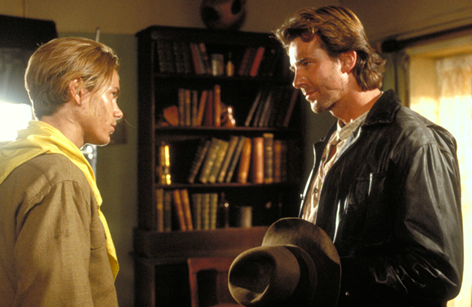
Overall, character depth was achieved, but personally, I believe that he could use even more character development despite what was already achieved.

Friday, February 7, 2014

O'Connell: Raiders of the Lost Ark

With Temple of Doom taking place so soon before the events of Raiders of the Lost Ark, Indiana Jones’ character goes through quite rapid changes. His rivalry with Belloq plays a contrasting role, displaying the moral superiority of Indy, but just a year prior, he and Belloq were identical, doing whatever it takes to reach goals for their own benefit. Monetary reward is only a small, technical concern to Jones, who only needs a sponsor to allow him to partake in another adventure. The US government acts as the lord to which he is sworn on his quest, but it seems that deep down his loyalties lie in the pursuit of the artifacts themselves, and his fascination with history. From what I understand, not having yet seen the film, The Last Crusade will see Jones graduate from servitude to a lord towards a more spiritually fulfilling goal, meaning that the Indy we see in Raiders is in just as temporary a state as the “anything goes” mercenary in Temple of Doom; he is never a perfect, stable, archetypal role. Ford himself mentions the depth of character as well, stating: “Jones is a character who has some other dimensions. He’s kind of a swashbuckling hero type, but he has human frailties, fears, and money problems, and therefore is more down to earth.” (Pfeiffer 115)
Look at him… fresh faced, and ready to serve America.


During the course of Raiders, Indy really just seems to be giving indentured servitude a try in his pursuit of recognition and his passion for history. A year earlier, he cared only for himself, and by the end of Raiders, he becomes disillusioned with his lord when they fail to live up to his expectations. He exhibits almost naivete as he accepts the mission and fulfills his duties at risk of life and limb, only to be let down by the government’s failure to meet his standards, as they hide away the ark rather than learn from it. But such is the life of servitude; it is not for him to question the motives of his lord. This seems to be what he learns in the final scene as he displays his dissatisfaction with the agents and storms down the steps of the government building. He is frustrated with the cause to which he pledged himself, and once again turns towards concern with the self, decrying the agents as “bureaucratic fools” and leaving with Marion, presumably cleaning his hands of government work and breaking off his service to the authority of a lord due to their inability conform to Indy’s ideals. This acts as a cliff-hanger of sorts, with an unsatisfactory conclusion that sets up Jones’ character for further development later in the trilogy, when he embarks on his grail quest to achieve spiritual fulfillment.

Lam: Indiana Jones and the Raiders of the Lost Ark


Indiana Jones and the Raiders of the Lost Ark
The Transformation from a Mercenary to an Indentured Knight


                Indiana Jones's evolution from a mercenary to an indentured knight occurs within Raiders of the Lost Ark, but this evolution in this particular film can also be viewed as a microcosm of Indiana Jones over the course of the original three films. In Raiders of the Lost Ark, however, the scene in particular where Indiana Jones becomes an indentured knight occurs in the image of the scene above. In this scene, Indiana just received news that the government decided to enlist his services to reach the Ark before the Nazi enemies do.
                This scene happens midway through the first half of the film, and the scenes leading up to this scene show stark contrast between Indiana Jones, the archaeologist, and Dr. Indiana Jones, the university professor. In the opening portion of this film, Indiana Jones acts as a mercenary and attempts to retrieve the golden idol in South America. This scene in particular shows off his recklessness as a character and his recklessness to pillage the cave of this idol. His motives for claiming this idol were fame and fortune. However, he understood the necessity for the idol to be placed in a museum. So at this particular moment, he acknowledges his sense of duty as an archaeologist, and in a sense, he already begins to answer towards an authority. This only gets overshadowed by his reckless, bold behavior, so he maintains his mercenary status. The next major scene shows Dr. Indiana Jones, his alter ego, teaching a class at a seemingly prestigious university. This indicated that Dr. Jones already achieved fortune by becoming a staff member of the university. Again, he begins to hint that he is giving into a greater authority, and this authority is personified as the university president (principal?). Dr. Jones works under him, and as a result, this indicates the progression from mercenary to indentured knight. By submitting to a higher academic authority, Dr. Jones fulfills the first half of the definition of an indentured knight -- indentured. He does not start his quest to become a knight until he reverts back to his other alter-ego of Indiana Jones after meeting with the government officials in the auditorium. Essentially, the first two opening scenes show the audience both sides of Dr. Indiana Jones and attempts to slowly inch him closer towards being an indentured knight. Ford even admitted to his character having several different sides, and specifically stated that his character was not a hero but was a person who did many brave things (Pfieffer 115). When Dr. Jones hears word of his appointment to this mission at his home, he begins packing his signature jacket and whip. It is at this instant that he accepted the job and agreed to work under the political entity.