Showing posts with label Indiana Jones & The Last Crusade. Show all posts

Tuesday, February 25, 2014

Lam: Indiana Jones and the Kingdom of the Crystal Skull -- A Parody


               Surprisingly, Indiana Jones and the Kingdom of the Crystal Skull had many parodies in the film that referenced back to both Indiana Jones and the Raiders of the Lost Ark and Indiana Jones and the Last Crusade. The references made to Raiders of the Lost Ark generally were related to Marion, while the references made to the Last Crusade were related to Henry Jones, Senior or the concept of the father. Among all of the references in the film, I feel the most prominent one is a mirror of a scene from the Last Crusade. During the scene when Indiana and Henry Senior escape the Nazis by motorcycle, Indiana laughs as they evade the Nazis, but Henry Senior scowls at him. This same scene is mirrored in Kingdom of the Crystal Skull when Mutt and Indiana evade the Russians on motorcycle again. Almost the exact same screenplay was used for that scene. However, it does include one major difference. This difference is the knowledge of the father figure. In Last Crusade, Indiana knew that Henry Senior was his father but chose to not to acknowledge him. Meanwhile, in Kingdom of the Crystal Skull, Indiana, at this point of the film, does not have the knowledge that he is anyone's, let alone Mutt's, father.

                This scene is a parody because it induces a mocking tone or pokes fun at a scene in a prior film and usually proves to be ironic. In this case, the situation is ironic because Henry Senior was a very serious and stout man who did not like Indiana's recklessness and his excitement and joy that came from the reckless behavior. Now, many years down the line, Indiana has aged and reached the age where "life stops giving you things and starts taking them away." After experiencing the loss of his father and Marcus Brody, Indiana finally becomes the father figure. This is partially what makes the scene so ironic. It is that Indiana has both become the father spiritually and physically with the introduction of Mutt's character. Mutt seems to be a more reckless version of young Indiana, perhaps due to the genes from both his mother Marion, a very fiery woman, and Indiana, an also very reckless man. In this scene, Mutt portrays the new reincarnated Indiana, but with even more vigor. Indiana does not exactly scowl at Mutt but instead gives him a glare. At the same time, you notice that it seems that Indiana even realizes that this was how he was when he was Mutt's age. The feeling did not seem to be one of contempt but one of reluctant acceptance that kids will be kids. Indiana takes this position until he learns that Mutt is actually his son. This parody almost seems as if the Indiana Jones franchise has run out of ideas with only the development of a son figure as the last chapter to Indiana Jones's life (Pfeiffer 176).

Friday, February 21, 2014

O'Connell: Last Crusade - Makeup

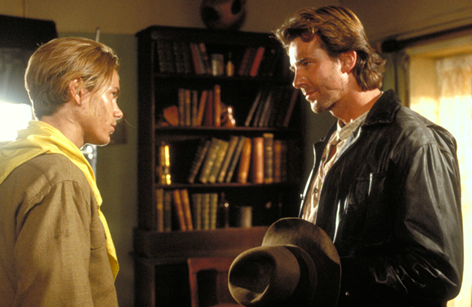
Taking place so far in the past, the opening scenes of Last Crusade make up for the lack of character development in the previous films, showing Indiana as not the ideal of masculine bravado we’re used to, but a young squire, exhibiting just a suggestion of the full-blown hero he will be in the future. River Phoenix’s performance perfectly suits adolescent Jones’ as a confident and educated young man with much of the daring do he is known for in the future, but as of yet holding little power and finding himself at the mercy of forces larger than him. The opening scene is a microcosm of Indiana’s later adventures as he puts his life on the line for his ideals, and ends up betrayed by those he seeks to serve -- in this case, the sheriff. It also elaborates upon the origins of a good deal of character traits that were otherwise left unnoticed. “Within a few precious minutes, the scene manages to explain the origins of everything from Indy’s fear of snakes to his acquisition of his trademark Stetson hat.” (Pfeiffer 180)


While in the past two films, Indiana is something of a male Mary Sue with his idealized, nigh flawless character and powerful screen presence, the opening scene presents to us a more vulnerable Indy, as is the theme throughout Last Crusade. Our hero is time and time again robbed of his dignity and seen with egg on his face. This allows us to see Indiana through his father’s scrutinizing eyes, making the opening scenes almost as illustrative about Henry Jones, Sr. as Jr. Going to his father for help after obtaining the crucifix, Henry Sr. fails to take his son seriously, and ignores his claims, instead forcing him to count backwards in greek. The emasculating shame Indiana feels reminds us that he is still only a child, and a shadow of the hero we see him as later in his timeline.


Indy hates the thieves for their selfish desires, reiterating his position that the artifact “belongs in a museum”. However, the man in charge of them dresses exactly like Jones does in adulthood. This draws a parallel between them, where Indy considers himself to have the moral high ground, but in the future he is little more than a glorified grave robber himself at certain points in his career, like during the events of Temple of Doom. The man plays the roll in Indy’s life that is later filled by Belloq in Raiders of the Lost Arc, snatching victory out from under him after he believes himself to be safe. At the same time, the man encourages Indy to continue his pursuits, giving him his signature hat and giving him hope for the future through negative example, displaying to him the graverobbing thievery to which he could succumb and motivating him to retain his ideals.

Friday, February 14, 2014

Lam: Developing Character Depth

Indiana Jones and the Last Crusade
A Closer Look at Indie's Character Development and Depth

                In the Last Crusade, I believe that the opening scenes tremendously added to Indiana Jones's character development. I wholly agree that the two prior films did not present a backstory to Indiana and only offered insight to who he was. The question of how he came about persisted until this third film where the entire opening sequence was fully dedicated towards provided a character history. I believe that character depth appeals towards the audience's emotions. The more that a character appeals towards emotions, the better the character will be remembered. If the character has a weak backstory that does not appeal to the audience, then the audience will not likely pay much attention to the character. However, if the backstory is strong and developed, then the character will be better remembered and ultimately contributes towards the depth of the character. Pfeiffer iterated that Indiana Jones was just a daring adventurer that seemed to just jump into our lives without any context, and that the character really needed a backstory to contribute towards his depth (Pfeiffer 114).


                Three main elements are presented in the opening scenes. The snake scene, lion whip scene, and fedora scene each gave Indiana a depth towards his character in explaining what made him who he is and gave the audience insight towards how he felt emotionally in certain situations. Originally, Indiana was not afraid of snakes when he and his friend first scouted out the cave where the treasure hunters were. However, when Indiana fell into the snake pit he developed a pathological fear of snakes that references back to Raiders of the Lost Ark when he went to retrieve the Ark. It significantly contributed to telling the audience how this fear of snakes developed as a child. 

The whip that he uses in the lion's den was what saved his life, so it was significant as it symbolized throughout all three films how he relied on his trusty tool to get out of any situation. Finally, the fidora essentially marked the beginning of Indiana's adventure in life, and it symbolizes his journey through life and thirst for adventure. Without this scene, audience members would ask, "Why a fedora?" It is a perplexing question that many may just take for face-value that it just adds to his physical appearance only, but by adding an emotional and historical reference to the fedora, it adds another layer of depth into Indiana Jones as a character. In essence, it makes his stories and adventures more believable if the backstory shows that Indiana started out growing up just like any other kid on the block. This is where the audience can finally connect with the character.

Overall, character depth was achieved, but personally, I believe that he could use even more character development despite what was already achieved.

Kunzig – Indiana Jones & The Last Crusade – Young Indy

    Revealing part of a character will always add some depth to his personality, makes him seem more human, more realistic, whether it's in a book or a movie. It allows the audience to feel like the character is less of a stranger, and more relatable. So to some extent these opening scenes automatically create some depth of character for Indiana, by showing us how he became what he is today.


    We learn that his passion for history and archeology dates back to a very young age when he sees the cross and knows immediately what it is, which is surprising for a young adolescent boy. When he arrives back at his father's house, we learn where his knowledge and interest came from – his father, who is copying in his journal an image of a christian stained glass, and makes 'Junior' count to 20 in greek, is obviously a bit of a history nut. We also catch a glimpse of the dog that we will later learn was called Indiana, and was the inspiration for Junior Jones to adopt that name.
    We also learn where his eternal fedora came from – it belonged to the tomb raider Indy tried to take the cross from. When the sheriff gives the cross back to the raiders, their leader puts his hat on Indy's head, and says "You lost today, kid. But that doesn't mean you have to like it." This scene establishes not only the meaning of the fedora, but also Indy's reason for distrusting authority, and even his persistent, fighting nature. Indy lost that day – he lost the battle but not the war. He eventually retrieves the cross.
    The scene in the lion's wagon on the train tells us what gave Indiana the idea that a whip would be a useful thing to carry around (because it is pretty weird). It is what saved his life in that moment.
And finally, it supposedly shows us where is snake phobia came from: he fell in a tub of snakes. But it is highly unlikely that someone would develop a phobia after an experience that caused them no harm, nor to anyone else, especially if this person had said ten minutes earlier "it's just a snake," and obviously felt no discomfort around it. If anything, he learned that he could fall in a tub of snakes and have two snakes stay in his clothes and nothing bad would happen.
    So while this history at the beginning of the movie does help create a fuller character for Indiana Jones, it also feels like a bit much. Every main aspect of his character has been stuffed into one short experience during his childhood. It also creates a contradiction: the two previous movies show us Indiana evolving from a mercenary, interested only in personal gain and selling important historical artifacts rather than giving them to a museum, into an archeologist who can accept a higher authority, values history and believes the ark should be studied and in a museum. But then this one shows that when he was young, he already valued history and believed the cross should be in a museum. So why would he go from that to what he was in Temple of Doom? If for instance, a relationship between the cross raider and young Indy was developed (the smiling and giving of the fedora really seemed like it should lead somewhere), it would make more sense.
    In summary, I think the opening scenes did add some depth to the character, but it should have either been further developed or not done at all.