Thursday, February 20, 2014

Munoz: Last Crusader (Make up)

Andres Munoz 
Blog week 5 (make up)


Indiana Jones (Harrison Ford) is a dynamic character in many ways, becoming a hero and a respectful man to going back to a mercenary, which only cares for fortune and glory. The Last Crusade was the best movie from the Indy trilogies because of many factors, thus tying up some loose ends on how Indiana became the famous bullwhip and fedora hat Indiana Jones. But this movie shows not only his character development but also the most important theme, which is his atonement with his father. In the beginning of the movie we can see a separation on the relationship as a whole in the family, considering as well the lack of a female role as the mother presuming she has died.
            Indiana Jones throughout the whole movie is constantly making it clear that it isn’t about the grail rather the rescuing of his father. This happens when Donovan is trying to recruit Indy and tells him that the man who was helping them and disappeared was the one and only Henry Sr. (Sean Connery). The first scene when we can see progress of the relationship is when they scape the castle where Henry Sr. was being hold, and are stuck in a decision to go to either Berlin or go to save Marcus. This discussion showed how Henry Sr. still has power over Indy, later on we encounter the issue where they are being chased by a Nazi plane fighter, Indy is without ammunition and Henry steps up. “The action sequences are woven into the story to allow Indy and his dad to demonstrate their own types of resourcefulness: Indy with strength and force, his father with ingenuity and wit.” (Pfeiffer, 180) Here they show a side where they can learn from each other to become a better person and to show that each one is unique in its own way.
            Another scene is when Indy is coming to the end of the cliff and falls with the tank. Here we can see Henry Sr. reaction shot towards the realization of “if he had five minutes more” and that he wants to have a better relationship. Finally we got to the last scene where both father and son reaches the atonement and becomes for the first time a family. In this scene they overcome a lot of trials to reach to the grail to save his father from death over a bullet wound. After saving his father, greed from Elsa manages to activate the booby trap. Indiana is holding his father one-handed for dear life, the other hand is trying to grasp the grail though it seem possible his hand being hold by his father is slipping, his father tells him to let it go. Indy realizes that he is being recognized and more important than a wholes life obsession with the grail.
            It was interesting how both Jones had a life obsession artifact that managed to get them in life and death situation though my question would be was it for the museum or his own fortune and glory re-capturing the cross of el Coronado.


Riewer: Last Crusade Make Up Blog

Throughout the final film in the Indiana Jones trilogy, The Last Crusade, the journey towards atonement with the father is a main theme. Indy and his father, Henry Sr., have an estranged relationship that is exemplified throughout this film and eventually mended. This is shown in several scenes throughout the film. 

The opening scene of The Last Crusade shows Indy trying to steal a cross from a group of thugs who want it for the money. Indy, on the other hand, wants to have it so that it can be put into a museum, where he feels it truly belongs. In his excitement upon getting away from the thugs, Indy first runs home to his father to show him his prize, but Henry, preoccupied by his study of the Holy Grail, completely ignores Indy. This is the theme of their relationship throughout Indy’s young life, as is proven by their relationship later in the film. This estrangement that is seen in this scene is what Indy and Henry, Sr. must overcome in order to achieve atonement with the father.


Later in the film, the journey toward the atonement with the father is shown when Indy is asked by Henry, Sr.’s colleague to go find a missing man, and Indy refuses. However, once he learns that the missing person is his father, Indy agrees to go on the dangerous search for his missing father. This proves that although Indy and his father have had a rough relationship throughout their lives, there is still hope and Indy is willing to do whatever it takes to make things work. In addition, this scene shows Indy, for the first time, going after something that is not monetary. He is not going in search of his father for the glory, he is doing it out of love. As Pfeiffer explains, “The device of introducing [Indiana’s] father played by Sean Connery was a stroke of genius” (Pfeiffer 175). What he is likely referring to is this new side of Indy that audiences are able to see; a softer side that is not solely driven by fame, fortune, and glory. 


The final scenes of the film show Indy and his father completing their journey to atonement with the father. First, Indy must traverse dangerous obstacles in order to attain the grail, as he and his father are being held against their will. Although Indy can not hear what his father is saying, it is implied that they have some sort of connection that helps Indy figure out the hard clues in the search for the grail. When Indy does finally take hold of the grail, he uses it to heal his father’s fatal wound, further exemplifying the process of their healing relationship. Later, the roles switch and Henry, Sr. must save Indy’s life. Indy, trying to finalize their healed relationship, makes an attempt to reach and grab for the grail but Henry, Sr. tells him to “let it go.” This assertion by Henry, Sr. shows Indy that their relationship is more important to him than the Holy Grail, and this completes their journey toward atonement with the father. 

Saliba Outline

Indiana Jones and the Last Crusade

I. Introduction
     A. Knight’s Journey
     B. Indentured knight vs. Grail quest knight
     C. Indiana Jones’ transformation from an indentured knight to a grail knight can be seen in three scenes from The Last Crusade. 

II. Scene One: “You’ve got the wrong Jones.”
      A. Indiana becomes an indentured knight to Donovan. 
      B. Lighting key
      C. Camera/character proxemics

III. Scene Two: Motorcycle scene 
      A. Indiana follows his father in the quest for the Holy Grail. 
      B. Angle 
      C. Character Placement 

IV. Scene Three: The trials before the grail
      A. Indiana learns from his father on his spiritual journey towards obtaining the grail.
      B. Lighting key

      C. Framing

Kunzig – Paper 1 Outline

Indiana Jones and The Last Crusade


Thesis: In this third film, Indiana Jones completes an entire cycle of the hero's journey, from beginning to end.

  1. Departure
    Scenes:
    • The call & refusal of the call: The collector asking Indiana to find the Holy Grail.
    • The crossing of the first threshold: Indiana discovering the crypt below the library.
  2. Initiation
    Scenes:
    • The Meeting with the Goddess: at the apartment in Venice, Indiana and Dr. Schneider get together.
    • Woman as the Temptress: in the German castle, Indiana learns that Dr. Schneider has betrayed him, and that his father also slept with her.
    • Atonement with the Father: After escaping from the German castle, Indiana and his father argue over which direction to take: Berlin or Venice. Indiana lets his father win: they go to Berlin.
  3. Return
    Scenes:
    • The Crossing of the Return Threshold: When Indiana, dangling in the crack in the ground, accepts that the Grail is lost and not meant to be part of the real world.

Conclusion
: While Indiana does phases of the hero's journey – departure, initiation and return –, every single stage within those phases does not apply to him. Some stages, such as Atonement with the father, may not actually be stages, because they last throughout the movie.

Gaspari Outline

In the last Crusade the knights quest is apparent, the holy grail is symbolic, and the idea of atonement with the father is clear. In my paper I aim to align the connection between the father and the son, and show how it is central to the idea of the indentured knight's quest. While the quest for the grail is symbolic in it's own right, the importance of saving his father and other scenes demonstrate that this is the true quest that Indiana must go on. Here are the three scenes that I am going to choose to analyze.

The first scene I am going to analyze will be the scene where Indiana finds out that his father has gone missing, and he decides to go to Venice. This scene is important because it helps show the cause of the beginning of the quest. It demonstrates the drive to get them going, and it shows that Indiana is going to save his dad, because he has gotten into trouble and now he has to bail him out.

The second scene I am going to analyze is when they are about to go to save Marcus but instead they go back to Berlin, this scene is important because it shows the first time that Indiana actually listens to his father and does what he asks. They have to go back to get the map, without it they would not be able to complete the quest, and get the grail, which will end up saving Dr. Jones' life.

The third scene I am going to examine is the last part of the film where they have just escaped the temple of the grail. Dr. Jones says that he has found illumination and they ride together on their horses. This scene is symbolic because it represents the father son relationship finally becoming realized by both sides and the successful completion of Indiana's Journey.

In conclusion I am going to show how the father son relationship is more central to the story line than the grail, because this film is all about the back story of who Indiana Jones is and part of that is showing his character in the scope of his father.

Friday, February 14, 2014

Whitman: Indie's Swagger Jacking Character Developement


If Jeffrey Boam set out to add character development to Indiana Jones then he most certainly did that. The first scene of the Last Crusade is layered with moments that explains all of Indiana’s character traits that exist in the other films.
The first scene shows that Indie wasn't always afraid of snakes, it was something that he developed. When Indie and his friend are watching the treasure hunters his friend is scared by a snake. To get rid of it young Indie grabs the snake and says something along the lines of it is just a snake. This establishes that Indie does not yet have his fear of snakes as he does in Raiders. While running from the treasure hunters on the train Indie falls into a crate of snakes. The camera proximity becomes much tighter so we can see Indie’s horrified expression. We can only assume that at this point Indie’s fear is developed and why later on in life Indie no longer says “it is just a snake” but “I hate snakes.”


In the opening scene Boam also establishes how Indie developed his whip toting style. While running away from the treasure hunters on the train, Indie finds himself trapped in a lion cage. His only defense is a lion tamer’s whip on the wall. This iconic moment of Indie using a whip for the first times establishes why it becomes one of his weapons of choice on his future adventures.


In Raiders when Indie is about to ride after the Nazis and try to get the arc back Sallah inquires as to how Indie plans to get the Arc back to which Indie replies, “I don't know, I'm making this up as I go.” This quote embodies Indie’s impulsive die-hard mannerism that recur multiple times through out the three films. We first see this style of problem solving start to develop in Indie when as young Indie he is asked how he plans to get away with the Cross of Coronado to which he replies, “I don't know, I'm making this up as I go.”
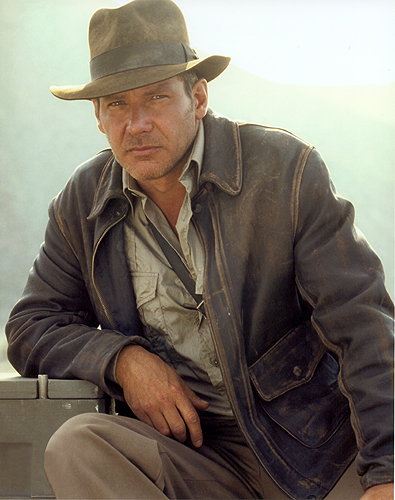
Even Indiana’s wardrobe is based on this opening scene from the Last Crusade. Through out all three films Indie’s classic look is a fedora/cowboy hat accompanied with a leather jacket. In the very last seconds of the opening scene, the veteran treasure hunter gives young Indie his iconic hat and instill within his never give up mentality: “You lost today, kid. But that doesn't mean you have to like it.”


The hat wasn't the only article of clothing Indie absorbed into his own wardrobe collection when compared side by side to Indie it obvious how much of Indie’s style was affected by this man. Hat, light button down, leather jacket, brown pants, they could switch outfits and we would be none the wiser.

Hoo: Indy's Daddy Issues

The third Indiana Jones film, Indiana Jones and the Last Crusade, seems to tie up many loose ends considering Indy’s character. The introduction of his father, Henry Jones Sr. played by Sean Connery, adds depth and more human qualities to this eccentric adventurer. It was an interesting decision for Steven Spielberg to choose to place such a robust actor in as Indy’s father. “Initially, the part of Professor Jones was to be a crotchety, aristocratic type of English gentleman – the type of character one would envision being played by John Houseman… Since Indiana Jones was his answer to James Bond, why not have the man who created 007 on-screen play Indy’s dad?” (Pfeiffer 176). Spielberg stated, “I figured Sean would give Harrison a run for his money… I couldn't imagine anyone with more screen power than Sean Connery to be the famous Indiana Jones’s father. Ford takes up a lot of the screen, and I didn't want diminishing any father in screen precedence. This greatly affects the strained relationship the dynamic of their father-son relationship.
            The strained between the two characters is made apparent in the first scene of the movie. After young Indy recovers the Cross of Coronado from the bandits, he returns home to seek his father’s guidance. His simply shrugs him off and continues on with his work. The frame does not even move to show Henry Sr.’s face. The sheriff then arrives and promptly gives the cross back to the bandits. The technique of not showing Henry Sr.’s face demonstrate the fact that Indy’ father was not around for him. This sets the stage for Indy’ future interactions with his father.
            A scene that displays Indiana’s progress in atoning with his father occurs when he observes his father’s ransacked house. Indiana realizes that his father’s prized Holy Grail Journal is missing. He then remembers that he received a parcel and then opens it. Sure enough, it is his father’s journal. Indiana then springs into action and knows he must go to Venice to save his father. It is interesting that he decides to go mostly because he wants to save Henry Sr. The Holy Grail quest is only satellite to his love for his father.

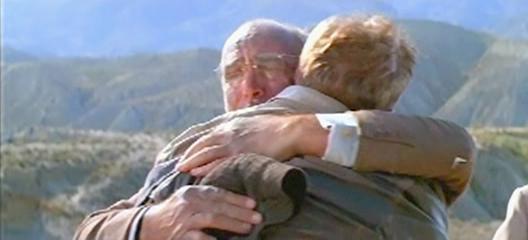
            The final scene I would like to discuss occurs after the audience, as well as, Henry Sr., Brody and Sallah think that Indiana is dead. The tank that he and Vogel are sparring on top of is seen tumbling off a cliff. The three men observe this and truly believe Indy is dead. Henry Sr. then states, “I’ve lost him…and I never told him anything. I Just wasn't ready Marcus.” Sr. is very upset and regretful. When Indiana shows that he is not deceased, Sr. gives Indy a sweet embrace and says “Well done.” These were the two things Indiana had wanted from his father his whole life. He wanted affection and validation and he only revived them after his father thought he was dead. Better late than never.