Showing posts with label John Hoo. Show all posts

Wednesday, May 7, 2014

Hoo: Patriot Game/Devil's Own

These two films attempt to portray the men of the Provisional Irish Republican Army in two very different lights. The core difference between the two films lies in how the filmmakers want the audiences to interpret the antagonists. In the 1992 film Patriot Games the character Sean Miller is presented for the most part as a pure antagonist. “Patriot Games had boldly presented the I.R.A. in an unflattering light, and Politically Correct forces began to attack the script’s allegedly right-wing tone. In fact, wile the I.R.A. is not painted in a glowing light, the story emphasizes that the terrorism is being caused by a splinter faction which the I.R.A. itself condemns” (Pfeiffer 202). Although the antagonist was part of a splinter faction, masses tend not to conduct extensive research on political issues like this one. I find that a great many of the audience members left the theaters with contempt for the I.R.A. Although Sean Miller’s struggle for vengeance stems from the fact that Jack Ryan killed his brother, he is portrayed as a pure antagonist. The frame I attached demonstrates the point that Sean Miller is to be viewed as a villain. While Miller is training in Libya it is obvious that he supposed to be evil. He is the last one to stop firing, showing his obsession with killing Ryan. Even though his is being advised to leave as the British Special Air Service is approaching to attack the camp he is persistent with shooting the target. The loose framing shows all the room he has to escape and how it seems not to matter to him. The desert color and backdrop demonstrates that this setting is of people hostile to the U.S. At the time the U.S. was involved in Operation Desert Storm and the desert was seen as the home of the enemies.


On the other hand, The Devil’s Own portrays a member of the IRA whose antagonist status is far more ambiguous. Frankie McGuire witnessed the murder of his father at the age of 8. This is the hardship that motivates him to commit such violence.  The audience does have sympathy for him, as besides the fact that he kills people he seems to be a good guy. The frame I chose demonstrates the complexity of his character. As the gunmen are leaving the house he backs up with his hands up. The high key lighting almost appears to be spotlight on him. This shows that the heat is all on him. Although his body language shows that he doesn't want any trouble, the stark contrast between him and his shadow demonstrate that his dark side will always follow him. Also, he is placed in a corner to show how he is stuck between these two lives.     
          

Friday, May 2, 2014

Hoo: Presumed Innocent

            The 1990 film Presumed Innocent starring Harrison Ford is a courtroom drama revolving around the innocence of Rozat "Rusty" Sabich. In the film Rusty is accused of the rape and murder of his colleague, Carolyn Polhemus. Rusty is a married man who once had an affair with the late Polhemus. She dumped him when he showed little ambition, meaning that he would not be able to help her career. This obviously makes the situation way more complicated. Rusty could definitely have a motive for killing Polhemus, considering he probably would not want his wife to find out about the affair. Also, Rusty was still obsessed with Polhemus so this could have been a crime of passion. Adding to the mystery is the fact that the audience is not informed of his innocence until the end of the film. As Pfeiffer states “The vulnerability of his character allows Ford to make mistakes and show weaknesses that would be unthinkable for make of the characters he had portrayed in the past. While we want to believe he is innocent of his lover’s murder and that he has truly rehabilitated himself as a family man, there is some doubt among the audience that he may not be quite what he seems” (Pfeiffer 187).      
            One scene that portrays this ambiguity is when he is called into his superior’s office. At this point he tells Rusty that his fingerprints were on a glass left at the scene of the crime. This causes the audience to question whether Rusty is in fact innocent. He was at her apartment the night of the murder and at this point is not looking very good for his case. He then reacts with anger to his peer that thinks he was the murderer.  
             Another scene that exhibits how the audience may think that Rusty is guilty is when Polhemus tells him that she is seeing someone else and wants to end their affair. He reacts very poorly to this. He reacts to the break up with great anger. He furiously grabs her arm as she attempts to leave her office.


             A third scene that exhibits his uncertainty of his innocence is when he and his attorney pay a visit to Raymond Horgan. His attorney then asks what he will testify. Rusty then calls him out on inconsistencies and then Raymond questions why his pints were at the crime scene. Rusty then asks how he thinks he could do such a thing. His face shows that he is clearly in a state of rage. In this frame Rusty is the dominant and his attorney, the subsidiary contrast. Rusty is angry and wants to react to Raymond’s betrayal, His attorney, the voice of reason, is contrasting with a calm demeanor. Rusty is only partially lit while his attorney is fully lit contrasting good versus evil, Rusty being evil.

Sunday, April 27, 2014

Hoo : The Fugitive

                The 1993 Andrew Davis film The Fugitive is a chase thriller that stars Harrison Ford. Ford plays Richard Kimble, a surgeon framed for the murder of his wife by a friend with the agenda of peddling a new prescription drug. The interesting part about this film is that the audience is not informed of Richard Kimble’s innocence until later in the film. Until it is explicitly revealed through a flashback that he is innocent and that a one-armed man really did in fact murder his wife, it is left up to the audience to decide whether or not they think he is innocent. Until the point where the audience is given this piece of information, there are little hints left by the filmmaker suggesting that Kimble is an innocent man. The first of these major hints occurs when he escapes form the bus transporting him to prison. Kimble is given the opportunity to either do what Is ‘right’ and save the life of the corrections officer who was stabbed by another inmate or go for the more selfish opportunity of escaping. He of course goes to save the life of the officer and drags him out of the wreckage, something the other officer would not even do. This demonstrates that Kimble has an even sounder moral compass than an officer of the law.

               
Kimble is confronted with another moral dilemma when he sneaks into his former work place, a hospital. As he is about to exit the hospital, he sees that his one exit point is blocked by a horde of cops. He then holds off on his departure and hangs back. He then observes a swamped hospital staff that was not properly attending to a young boy. A doctor then requests him to send this boy to another department in the hospital. His inclinations as a doctor then kick in and he looks at the boys charts and realizes that he needed surgery. It is a convincing portrayal of a doctor as “Harrison Ford indulged in intensive research for his role as a physician. He accompanied actual doctors on their rounds, socialized with them, and watched them prepare for surgery” (Pfeiffer 208). He then made the proper adjustments to the boy’s charts and sent him into surgery. His actions actually ended up saving the boy’s life. Kimble was presented with another moral dilemma and ended up again making the non-selfish decision to help another person despite the risks. The easier route for Kimble would have been to simply send the boy where the doctor requested him to and gotten the hell out of there. Instead he chose to help the boy. This benevolent decision hints at his innocence. A man who murdered his wife would have no problem with sending the boy into the wrong wing for the sake of his escape. Kimble’s innocence is suggested through this scene.          

Thursday, April 10, 2014

Hoo: Mosquito Coast

The 1986 Harrison Ford film The Mosquito Coast is my personal favorite film out of the movies we have watched so thus far. I really enjoyed the themes explored in this film. Also, the film did not have a typical structure that most films tend to follow. I could actually tell that the film was based on a novel because it did not have the traditional plot structure with a very obvious climax. The most interesting themes presented in this film had to be the different forms of imperialism and the irony apparent in both forms.

Theroux clearly wanted to draw parallels between Allie Fox and Reverend Spellgood. The most obvious way that he made the put the two on the same pedestal was the way that their followers referred to them as “father.” This was a very interesting revelation once the locals began to call Allie “father.” This signaled a change within Allie. He has now become what he left America to avoid. The scene when the family and locals first begin constriction on the utopian society reveals a lot about his scheme. He states to the crew “I'm here to work for you. And if I'm not working hard enough, you just tell me and I'll work harder.” This was a way that he gained everyone’s favor. He has the kind of charisma that a politician or dictator possesses. He tells the people what the want to hear in order to get them to do what he wants them to do. The types of imperialism that he represents are political imperialism and economic imperialism. He manipulates how the people think and he seems to meet all of their needs. He is at political odds with Reverend Spellgood and at first he delivers on his promise of a better life for the natives of Jeronimo. His economic influence comes from his monopoly of food and ice production. He is the only one who has the ability produce the ice.

Reverend Spellgood, “the fire and brimstone missionary,” (Pfeiffer 159) represents a different kind of imperialism – religious imperialism. He entered the jungles of Central America with the agenda of converting the natives to Christianity. His promise of eternal salvation and amenities of the modern age convinced the natives as the ice did for Allie. The scene where the Foxes disembark from their raft onto the Spellgood camp is a perfect exhibition of this type of coercion. As the family approaches the chapel they observe the natives thoughtlessly watching a large television with a prerecorded sermon playing. The sermon features Spellgood talking to the natives like little children. This is another commonality that Allie and Spellgood share: they both view the natives as savages that can be easily manipulated.      

Friday, April 4, 2014

Hoo: Witness

In Witness, Harrison Ford’s character, John Book undergoes tremendous changes throughout the duration of the film. Being transplanted from Philadelphia’s inner city into an Amish community in Lancaster County, PA causes a few different types of change within Book’s character. One of the most interesting changes that occur is a moral one. Although most of the alterations made in Book are for the positive there is one negative moral change. When Book first brings Rachel and Samuel to his sister’s house for safekeeping he makes a snide comment to his sister about having different men over while her children are sleeping. This demonstrated Book’s strict moral code and how he looked down on his sister for being morally unsound in his eyes. However, after he ends up falling for Rachel, he may have made love to her the same house in which her son was sleeping. This is an obvious deviation from his moral code and he can be seen as a hypocrite for doing exactly what he was chastising his sister for doing. In fact, the in which the two ended up making love was deleted in order to create a “’what-if’ element to their relationship” (Pfeiffer, 152). 
            Another way Book changed was the fact that he ended up truly caring for one of his witnesses. In the beginning of the film he just treated Rachel and Samuel as a means to an end. He had no problem with slamming an innocent man’s face against the window in order for Samuel to profile him. Doing this to any young child would be terrible but he exposed a boy from a culture and religion that preaches pacifism. However, after being emerged in the Amish community, Book clearly starts to grow fond of Rachel and Samuel. The connection to Rachel is obvious but he even goes out of his way to build Samuel an intricate marble run. Another way Book changes over the course of the film is hat he learns to take responsibility for his actions. In the beginning of the film he seemed to have no disregard for others in his pursuit of justice. After staying with the Amish, he demonstrates his ability to take responsibility for his own actions. The most obvious illustration of this is the fact that he repaired the birdhouse he destroyed when he arrived.

            There was a way that Book did not change. Book was just as violent at the end of the film as he was in the beginning. The reason the cops ended up finding him in the first place was because he found it necessary to punch the tourist picking on the Amish. Also, at the film’s conclusion he ended up killing two of the cops that were after him. This shows that perhaps it was better that he returned to the city and left the Amish in peace.               

Thursday, March 27, 2014

Hoo: Director's Cut


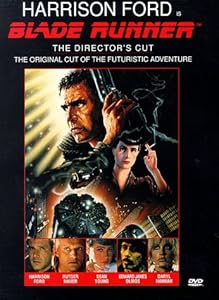
There is a very noticeable difference between the two versions of the Blade Runner films. In my humble opinion the later version, Ridley Scott’s Director’s Cut is far superior to the original film released in 1982. The two versions can almost be seen as different films. It is interesting to note that Ridely Scott did not personally create the Director’s Cut. He actually provided extensive notes and consulted with Warner Bros. Film preservationist/restorer Michael Arick was then put in charge of creating the Director's Cut. Scott cites his time obligation to the film Thelma and Louise and money constrains as the reasons why he was not entirely able to rework the Director’s Cut to his full satisfaction. This being said, the most noticeable difference between the 1982 and Director’s Cut versions is the removal of the voiceovers in the Director’s Cut. I find that this difference definitely makes this version an overall better film. I found that the voiceover really served to insult the intelligence of the audience. Granted, the test audiences for the first version of the film were confused without the voiceovers. However, Ridley Scott has stated that the confusion form the lack of information was the effect he was looking for in the film. I believe that the audience should not be simply handed the background information, but rather they should be left thinking a bit. This is the role the removal of the voiceovers in the Director’s Cut serves. In addition to removing the voiceovers from the original version of the film, there is a dream sequence added. “Scott…insisted that the unicorn dream sequence be inserted into the film. Although the studio had originally vetoed the inclusion of the unicorn, this time Warner Bros. agreed” (Pfeiffer 127). In this sequence, the audience observes a dream of Deckard’s. In this scene there is a tracking shot of a unicorn running. The inclusion of this sequence implies a lot about Deckard and allows for the audience to speculate. The dream could imply that Deckard is actually a replicant. In connecting Gaff’s origami unicorn to the dream, Scott may be getting at the possibility that Deckard’s dreams are already known to him (his memories are artificial and therefore so is he). Another major difference between the original film and the Director’s Cut is the exclusion of the studio imposed happy ending. In the Director’s Cut the film simply ends with the closing of the elevator doors. I enjoyed the ambiguity of this ending far more than the original. The original ending was far too cheesy and removed any sense of mystery, as did the voiceovers. All in all, the Director’s Cut was a far better version of Blade Runner. The added uncertainty allowed for some mystery and the speculation of the audience.