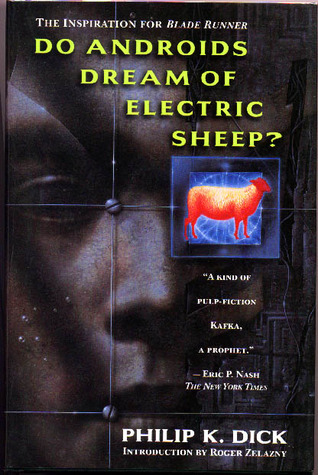
Michael Heilemann’s essay promotes many interpretations of Do Androids Dream of Electric Sheep that are relatively obvious and acceptable, however in his conclusion, he postulates that in relation to the androids, the novel’s “real” humans are:
Stupidified by 23 hours of moron-TV every day, unable to provoke emotions except through a mechanical device and blinded by their devotion to their new religion. A religion which no one really understands or even makes an effort to understand, it’s merely accepted as yet another possibility of total escapism. (Heilemann 12)
This is an opinion that I feel conflicts with many of the novel’s statements about humanity, and the nature of Mercerism.
Though Mercerism is presented as a religion, I believe its role for mankind is not to inspire blind devotion or similar escapism to Buster Friendly’s 23 hour broadcast, but to remind the followers of their humanity. Empathy is the measurement by which the androids are considered insufficient to be human, therefore the greater one’s empathy, the greater their humanity. Through reassurance and communal compassion, the Mercerists are kept in touch with their truly human natures. Not necessarily by literal definition, as a man like Phil Resch, though human, is a killer, lacking in the (figuratively) humanizing empathy. New, updated versions of androids are constantly being released, getting closer and closer to this ideal of human that many humans are unable to reach. Luba Luft criticises Resch openly for his android-like lack of empathy, to the point that she is convinced he is one. After being given the book of Edvard Munch prints by Deckard, Luft says of Resch “It wouldn’t have occurred to him; as he said, never in a million years.” (Dick 133) As the line between organic and electric is already blurred to this point, the androids are obviously on a track towards indistinguishability from humans as they improve and get closer to empathic response.
It is not simply the humans’ attempting to foster artificial exclusivity by stating the unachievable by the androids. Consider Isidore’s distraught conversation with the Mercer via the empathy box, immediately after his exposure as a fraud.
“I am a fraud,” Mercer said. “They’re sincere; their research is genuine. From their standpoint, I am a retired bit player named Al Jarry. All of it, their disclosure, is true.” [...] “They will have trouble understanding why nothing has changed. Because you’re still here, and I’m still here. (Dick 214)
The point of Mercerism is not the divinity of the figure, Mercer, but the empathy itself through the vehicle of Mercer’s ceaseless pilgrimage and hardship. It is only the lack of compassion that keeps androids from achieving humanity. Theoretically, if the androids were to reach such a tier of empathy, they would finally be truly equal to humans.
Works Cited
Dick, Philip K. Do Androids Dream of Electric Sheep? New York: Ballantine,
1996. Print.
Heilemann, Michael. “Do Androids Dream of Electric Sheep and Blade Runner”. 2001. Blackboard. Web. 13 Mar 2014.