Thursday, February 27, 2014

Miller: Parody of Indiana


Michael D. Miller
The Kingdom of the Crystal Skull

Parody of Indiana

Indiana Jones and the Kingdom of the Crystal Skulls includes a number of parodies of not only Indiana Jones films, but one other that jumps out off the screen that must be mentioned. The scene when Henry “Mutt” Williams, Jones III is riding along the train platform to find Indiana. Mutt is dressed in the same costume as Marlon Brando in the movie the Wild Ones. The motorcycle, the leather jacket, the way he wears his cap tilted to the side and how he plays with his switchblade, all are Brando-esque.


            The first parody observed was of course the scene when Indiana escapes from the Russians out of “Warehouse 51” and crashes through a number of crates. The camera pans closer to one of the damages crates to reveal the Ark of the Covenant. The first treasure that Indiana recovered during the Raiders of the Lost Ark that was later taken from him and locked away in a government warehouse.
            One parody that stood out in the “final” Indiana Jones film was the scene where Mutt and Indy are being chased by the Russians through the campus of Marshall University. Mutt leads the chase through the quad where there are a number of students protesting against the Russians, “I’d rather be dead than RED!” As the banner falls across the windshield of the pursuing Russian KGB agents, they crash into a statue of Brody. The head of Marcus Brody comes crashing through the windshield and lands in the KGB agents lap. This is obviously a remembrance of Marcus Brody (Denholm Elliott) who appeared in all three previous Indiana Jones films and who was a trusted friend and confidant of Indiana. Mr. Elliott had passed away a few years after the Last Crusade. Indiana also remembers Marcus earlier in the film when he is at his home with the Dean Stanforth (Jim Broadbent) and makes reference to the passing of both Marcus and his father.  
            Another parody that garnered much attention was the ending of the chase scene with Mutt and Indiana crashing into a student in the library. The student poses a question to Dr. Jones about his research and Indiana replies that if the student wants to learn more about archeology he has to get out of the library. This directly contradicts his previous advice to a student in the Last Crusade when he tells the student that seventy percent of all archeology is done in the library. Research and reading. This shows how the adventurous side of Indiana overcomes the Professor side of him. He knows that through his experiences he has learned so much more by exploring the ancient ruins himself as opposed to reading about the same places in books taken from mythology or possibly another person’s experience.
            Throughout the Kingdom of the Crystal Skulls film, the antagonist Irina Spalko, is taking Indiana’s found treasure away from him. Just as in the first film, Raider, when Belloq takes the idol and then the Ark. Much in the same way in Temple of Doom, when the Thuggie Cult members take the magical stones away from Indiana. And finally, in the last Crusade when the Nazis take the Grail book away from Indiana. However, in the end Indiana manages to escape with a new level of awareness and consciousness. Such as in this film, Indiana did not believe is supernatural beings from another world and it was not until he entered the alien room and seeing the interdimensional craft depart from the Mayan ruins did he truly believe and of course he gains a son and a wife in this final film.    

Wlos: Crystal Skull


          Indiana Jones and the Kingdom of the Crystal Skull offers a fresh look at the iconic American film hero, Indiana Jones.  The film features him in a new light as his characteristics are now much more reminiscent of those of his father in The Last Crusade.  Likewise, a new character, Indiana Jones's Son, Henry "Mutt" Williams Jones III, is introduced, and he displays many traits of the younger Indiana Jones.  This is easily observed 79 minutes into the film when Henry is seen battling on top of cars in the same manner in which Indiana Jones battled on top of a tank in The Last Crusade, while Indiana Jones is seen filling a role similar to that of his father during the The Last Crusade's tank scene.  This comes to show us that fathers and sons can be very similar, but sometimes that is only seen when they are thrown into similar circumstances.  The way the Jones men react to situations that are essentially constructed to be similar is a great example of this.  
The circumstantial happening of this particular seen illustrate Henry Jones as a gleaming image of his father.  There are plenteous references to his father's previous experiences during this scene.  One such instance is when he is thrown off of the car and into a tree that is occupied by a large number of monkeys.  This is actually reminiscent not of the battle tank scene, but of the seen in The Last Crusade that features Indiana Jones battling men onboard a moving train, and constantly falling into cars occupied by animals.  
This scene is similar to the battle tank scene as it features a young, cunning man fighting a military professional with hand to hand combat while standing on top of a moving military vehicle.  The position that Henry finds himself in is rather similar to Indiana Jones, he is constantly knocked around, almost off of the vehicle, but is able to barely hold himself on.  Another thing to look at is the fact that he's a young man getting beat up, but he refuses to give up and just keeps going.  He's an echo of his father.
Likewise, while this is going on, Indiana Jones takes a stance that is similar to the position his father took during the battle tank scene.  He remains in the vehicle, like his father, and battles for control of it. And at the end of the sequence, Indiana shares a little celebratory moment with his son, each saying "Woah,"  treating his son very similar to the way his father treated him in Last Crusade.
Overall, this film shows the ways in which we resemble our parents.  I believe the reason why The Jones men resemble each other so much is because they are naturally similar, being fathers and sons, and they find themselves in similar situations and thereby react in parallel ways.  It makes me think of what I'd be like if I followed my father's footsteps.  Or what he'd be like if he folioed mine, for that matter.

Andrew Wlos


Jordan-Crystal Skull


The 4th installment of the Indiana Jones film series, Indiana Jones and the Kingdom of the Crystal Skull is a film that I see as a parody  of the previous 3 films. The film seems as if all other ideas where exhausted and the film felt like a rehashing of old material.

 The film was certainly not perfect, but unlike most I did not think the problems were in the silly set ups and 'get out of jail free' solutions to perilous situations. If this film has a serious problem it was probably the story. It's just plain hard to keep track of most of the time. There is a tremendous amount of exposition (probably more than in any other Indy film), and if you aren't paying attention – and I mean like there's gonna be a quiz on this at the end – it's really easy to get lost. Particularly when it comes to a crucial plot point about someone taking the skull, bringing it somewhere, failing to unlock a puzzle, and taking it right back again.

Another interesting fact about this film, in fact what may have been too big a hurtle in the eyes of some, is that the 'deal breaker' scene comes very early in the film, and to protect those who have not yet seen the film, this deal breaker comes in the form of a refrigerator. As soon as this scene was over I said to my self "this is the point of no return. If the audience cannot accept this, they won't be able to accept anything else in the film". I did accept it, and once I sat back and said "whatever" (Indiana Jones films typically require extra suspension of disbelief) I had a great time at the movies. The Indiana Jones franchise has never been about the stories; not really. Indiana Jones has always been about having as much fun as you can in a movie, and I have to say this movie was a lot of fun.

Wednesday, February 26, 2014

O'Connell: Indiana Jones and the Kingdom of the Crystal Skull

Indiana Jones and the Kingdom of the Crystal Skull is a notorious film for tacking one more attempt at greatness on to the already complete series, but to say one thing in its favor, it is definitely a work born of passion for the earlier films, especially Raiders of the Lost Ark. Packed with reference after homage after fedora tip, the film is a love letter to the earlier trilogy with countless tributes to the other films.


The scene taking place at Jones’ residence wherein Indiana has just learned of his “indefinite leave of absence” is especially packed with references. Structurally, it is the same as the scene in Raiders of the Lost Ark in which Dr. Marcus Brody shows up to tell Indy of the new mission and share a celebratory drink, however the drink he shares with Dean Charles Stanforth is a mournful one as the two men are both out of work. This time, Indy is not packing with eager anticipation, but with disheartened acceptance. Note how instead of first grabbing his trademark jacket and coiled leather whip, he first packs neatly folded shirts, underwear, socks, and a coiled leather belt, a sad image of the adventureless life that awaits him.

Similar to Indiana’s disillusionment with the government in the end of Raiders, there is a continued animosity towards the government in this film and this scene, as Charles states “I barely recognize this country anymore, the government’s got us seeing communists in our soup. When the hysteria reaches academia I guess it’s time to call it a career.” (Spielberg, Crystal Skull) After his run in with the government agents at the beginning of the film, Indy is no more thrilled with them than he was in ‘36. When the agents come to the university to search Indiana’s office, Charlie must to allow them, but is forced to resign as he defends Jones. During their conversation, Indy apologizes for having doubted Charlie’s loyalty, who then responds “no, you have reason to question your friends these days”, referencing both the betrayal of Mac in this film, and on a larger scale the constant betrayals of Jones’ many companions over the years.

This scene looks back in many ways, as Indiana is struggling with his own mortality. We learn that in the recent past, both Marcus Brody and Henry Jones, Sr. have passed away, leaving Indy with few companions, and he looks through an old journal that quickly flashes upon a picture of a youthful Indiana who has also gone the way of all things. Indiana has little to look forward to at this point, and instead both Indy and the audience are nostalgically remembering the glory of the past.

Sanderson - Kingdom of the Crystal Skull


        The interesting things about Indiana Jones and the Kingdom of the Crystal Skull are that it is a well-done parody. The parodies that I have become accustom to have been done with the actors of the films that they are making fun of and they surely aren’t done with the director either. I find that it gives this movie credit that other films like this don’t get. It defiantly makes it funnier just because we get to watch a Indiana Jones film with the Harrison Ford instead of some C list actor trying to portray him in a corny manner. Its always more funny when someone is making fun of themselves as opposed to someone else making sense of them. 
The scene that I picked is the scene when with the atomic explosion. What I found to be the parody is that just like all the other Indiana Jones films, Indy finds some crazy way to avoid an inevitable death. Indy finds himself in an abandon nuclear test town. He is surrounded by dummy’s set up in this town. I found this to be a connection because usually Indy is constantly surrounded by people that he has to save and you could call these people dummy’s as well. Anyway, Indy left by the only live people in the town and he has to find somewhere to hid from the explosion. He hides in a lead lined refrigerator in one of the houses. The bomb goes off and blows Indy and the fridge hundreds of yards through the air. When Indy lands he rolls out of the fridge. Of course he is unharmed and his hat is still on his head and he still has his whip. No matter what ever happens to Indy, he always has his hat and his whip. 

What makes a parody funny is the ridiculous things that can happen that don’t have to be explained. Whether it is how Indy never gets harmed or how he gets out of completely ridiculous situations, the film has the ability to cross the line because it is a parody. What makes this parody special is how well it is done. Sometimes parody’s are funny because of how poorly the action scenes are or the acting. In this film the graphics are actually really good and Harrison Ford being in the film really makes it. 

Cacique-Borja, Crystal as Bonus

Crystal as Bonus

Kingdom of the Crystal Skulls was set in 1949; eleven years after The Last Crusades, where we last see Indy establishing a healthy relationship with his father. Interestingly enough, Kingdom of the Crystal Skulls is also about remedying a son to father relationship only this time Indy is the father and his son has been unknown to him for quite a while. In this movie, we see an older Indy who is not as muscular (because the camera no longer focuses on his arms nor are his sleeves rolled up like in The Temple of Doom) or agile but definitely a wiser Indy who waits before he whips out his whip. (Interestingly enough, Indy looks about 20 plus years older.) Just as in the previous movies, the audience does not get to witness Indy’s full facial profile until it is established that he is a figure who demands attention and diligence. Indy’s legendary fedora shadowy figure puts the soldiers at arms as he is thrown into the concrete and his impossible journey through death staring obstacles begins.

The introduction of the female villain in the opening scene revives thoughts of Gretta Von Grimm from The Last Crusaders when she sparked a sexual tension between her and Dr. Jones. The new villain, Dr. Irina Spalko does not prove to be the temptress Gretta was but she does manage to be a pain the way Belloq, the “French archeologists in league with the Nazi” was (Pfeiffer 117).  As Indy is escaping from Dr. Spalko in the military warehouse he drives through a cluster of wooden boxes. In one of the crashed and opened wooden boxes resides the lost Ark where “the Ten Commandments were placed by Moses” and Indy had risked his life to rescue from the Nazi in Raiders of the Lost Ark (Pfeiffer 117). The Ark represents the belief Indy had had on authority, the USA government, to recover artifacts for the better of humanity. Indy went into the mission believing that if he found and retrieved the Ark before the Nazi did and gave it to the government he would further human knowledge. As it is seen in the last scene of Raider’s, Indy is told that the “top guys” were on the Ark when it was actually being taken into storage in a military warehouse not to be laid an eye upon by humans as Indy had hoped. The revival of the Ark, parodies the grim chapter in Indy’s life when he loses the opportunity to study the Ark only to have him literally drive through it. Ironically, Indy’s obsessions with artifacts, which lead him to the Arckat one point, once again lead him away from it. 

Tuesday, February 25, 2014

Murray- Crystal Skull

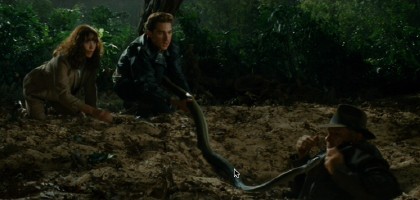
Once scene that is a parody of thee earlier films in the Crystal Skull is when Indy is caught in the quick sand and must grad the snake in order to pull himself out.  Throughout the films it has been brought to the viewers’ attention that Indy is terrified of snakes.  This is his one weakness.  Instead of powering through the fear he has like usual Indy is rendered practically helpless.  It is making fun of the idea that he is a fearless warrior.  Instead, he is more childlike than ever before.  In Raiders Indy is trapped in the snake pit but uses fire to fend off the snakes.  His intellect is what saves hi from his greatest fear but in this case instead of being able to deal with the situation at all Indy must simply let go of his fear.  Intellect would tell Indy that the snake grabbed would kill its pray by constriction not venom.  Therefore, he would not have any fears about grabbing the snake but he is helpless.  Logic fails Indy in this instance.  Instead of being the iconic male that we know him as Indy is a child.  The bravado is gone. It also reflects the fact that Indy must face his fear of snakes in all phases of his life.  In The Last Crusade, Indy must face the pit of snakes in his youth.  In Raiders of the Lost Ark Indy again has to face snakes as an adult.  Now in the Crystal Skull Indy is facing the same old fear only as a matured adult.

            Another aspect of the scene that is a parody is Ox going for help.  Indy almost never asks for any type of help.  He asks for favors and when sticky situations arrive he deals with them on his own.  In this case he is rendered helpless and must beg for Ox to come get help.  In return Ox brings the Russians that Indy was trying to escape from has help unknowingly.  This plays into the idea that Indy can never win.  With him everything that can go wring does.  Playing into the same sentiment is how Indy and Marion get stuck in the first place.  Indy points out that, quicksand is rather harmless unless the air pocket inside pops.  Of course as he says this the air pocket bursts putting him in danger.  This mocks the concept that the worst always happens to Indy.  Even when Indy thinks he is safe something occurs which puts him in danger.  In particular it is mocking the scene from Raiders where Indy puts the bag of sand and takes the Idol.  Instead of the plan working the bag of sand is too heavy and triggers the booby traps the moment Indy looks away.  Just like in the quicksand Indy believes he has managed to secure a situation that is not putting him in danger but in reality as soon as Indy thinks he is safe everything collapses around him.